Showing posts with label Singer: Asha Bhosle. Show all posts

Wednesday, July 21, 2010

S. D. Burman: Taxi Driver (1954/1977) Pakistan

Ok, ok. I actually enjoyed the Taxi Driver soundtrack more than Chalti Ka Naam Gaadi. And I have to admit that I am finding some S. D. Burman songs which I enjoy very much (hey, don't even think about it...this doesn't mean that I am a S. D. Burman Fan). I have still to find an entire "Dada" album that impresses me. To date, this is the closest, if you don't count Aradhana (composed by S. D. Burman/R. D. Burman). And bizarrely enough S. D. Burman won the Filmfare Award for best music director in 1955 for the song "Jahen To Jahen Kahan" and not for the entire album. Actually, the first two years the award was given, it was awarded for a song not an album (Naushad won it in 1954 for "To Gauga Ki Mauj" from Baiju Bawra).


I agree with Filmfare on this one, I very much enjoy Talat Mahmood's version of "Jahen To Jahen Kahan". I usually associate Mahmood with Dilip Kumar, and Dev Anand with the equally talented Hemant Kumar (aka Hemanta Mukherjee), but this combo does just fine in the picturization of this lovely tune. Lata also takes a stab at the same song but I it's left emotionless next to Talat Mahmood's version.

I also admire "Dil Jale To Jale", an "almost vamp song" for Lataji with its catchy and fine swaying melody. Do like the two little gore playing instruments in the band (I just had to post pics...).


The duet "Dekho Mane Nahin Roothi Haseena" is good and playful. Yet I still don't know exactly who the male playback singer Jagmohan is? My closest guesses are either Jagmohan Bakshi a music composer, associated with Sapan Sengupta for the Sapan & Jagmohan team, or Jaganmoy Mitra the Bengali singer.


Also worth a listen is "Ae Zindigi Aaj Raat Jhoom Le". But I would have liked it if the intro to the song (shown in the link) would have been on the record. To bad.


Overall, this album is worth a listen, and I hope you appreciate it more than I do.


Tracks


Side 1
1. Asha Bhosle: Jeene Do Oji O
2. Lata Mangeshkar: Jaen To Jaen Kahan
3. Asha Bhosle & Jagmohan: Dekho Mane Nahi Roothi Haseena
4. Lata Mangheshkar: Ae Zindigi Aaj Raat Jhoom Le

Side 2

5. Kishore Kumar: Chache Koi Khush Ho Chahe Galiyan Hazar De
6. Talat Mahmood: Jaen To Jaen Kahan
7. Lata Mangeshkar: Dil Se Milake Dil Pyar Kijiye
8. Lata Mangeshkar: Dil Jale To Jale


Lyrics: Sahir

Stella_1's score: 3.5

Get the music Now: S. D. Burman Taxi Driver

Monday, February 15, 2010

S. D. Burman: Chalti Ka Naam Gaadi (1958/1989)

Chalti Ka Naam Gaadi is not my favourite soundtrack nor is S. D. Burman my favourite composer. None the less, this hindi comedy does have it's own charm. Kishore Kumar's "Ek Ladki Bheegi Bhagi Si" is the best song on the record, and is today considered a classic.

For a comedy, which usually tends to lack in the song department, this record tries its best to cater and reach out to the common city folk with it's modern upbeat music. I like it because its, in a way, unsophisticated and humble which makes it easy to relate to and accessible to everyone.

One of my favorite songs on the record is "Tum Tumare Hain". It's performed by the lovely Helen with her dance mentor Cukoo.

But the most important figure on this album and the "soul" behind the songs comes from Kishore Kumar's voice. He acts through his singing, this very strong asset of his makes listening to the record worthwhile. Enjoy.


Tracks:


Side 1

1. Title Music
2. Kishore Kumar & Manna Dey: Babu Samjho Ishare
3. Kishore Kumar: Ek Ladki Bheegi Bhagi Si
4. Kishore Kumar: Hum The Who Thi
5. Kishore Kumar & Chorus: In Hathon Se Sabki Gaadi


Side 2

6. Asha Bhosle & Kishore Kumar: Haal Kaisa Hai Jabab Ka (with dialogue)
7. Asha Bhosle & Kishore Kumar: Main Sitaron Ka Tarana
8. Asha Bhosle: Ruk Jao Na Jee
9. Asha Bhosle & Sudha Malhotra: Hum Tumhare Hain


Lyrics: Majrooh

Stella_1's score: 3/5

Get the music now: S. D. Burman Chalti Ka Naam Gaadi

Friday, November 6, 2009

Shankar Jaikishan: Bombay Talkie (1970)

Bombay Talkie is quite a find. The music, by Shankar Jaikishan, is the only collaboration between themselves and the famous Merchant-Ivory film team (Ismail Merchant and James Ivory). The english film, starring Shashi Kapoor, his wife Jennifer Kendal and Zia Mohyeddin, mostly takes place in Bombay of the late 60's early 70's. Vikram (Shashi Kapoor) is an aging hero stuck in an unhappy arranged marriage with his wife Mala (Aparna Sen). Lucia, a three time married middle age novelist, takes a liking to Vikram while Hari, a Bombay screenwriter, madly in love with her, does as she pleases. This has to be my favorite Merchant-Ivory film ever! But I won't say any more than that, as I will probably review the film one day. For now, let me talk about some of the soundtrack's great songs.

The tracks comprise, mostly of various versions of the Bombay Talkie Theme, "Title and Theme" can be heard in the Title Credits along with "Tum Mere Pyar Ki Duniyamen" a few seconds before that. In this particular sequence, the "Title and Theme" is played as hand painted portraits (filmi style) of the cast and crew are shown around the streets of Mumbai.

Besides the theme variations, five, of what we can call conventional, songs are found on the record. Along with the previously mentioned "Tum Mere Pyar Ki Dumiyamen" you have to start with the great and famous "Typewritter Tip Tip Tip" song because, well, just because. With the fantastic Helen and Shashi dancing on a giant typewriter, what else do you need. A young and spunky Usha Lyer gives us two versions of "Hari Om Tat Sat" (हारी ॐ तट सात). One is the orchestrated version which is
the film version and the other version is the "official" version. She also sings the vocals to the Bombay Theme tune "Good Times, Bad Times".


As for the variations I enjoy the "Rajput Suite" "Now I Shall Call You Ma" and especially "Picnic in the Cave" with it's new wave synthesisers.

Overall, though it's not entirely a commercial Hindi film soundtrack, it is very enjoyable and interesting to listen too. As much for it's filmi songs, instrumentals and some rare Usha Lyer (now Usha Uthup) tunes. Just listen for yourselves!

Oh, and once your done listening to the music, those who have not seen the movie yet, rent it or buy it NOW!


Tracks:

Side 1

1. Instrumental - Title and Theme
2. Mohd. Rafi - Tum Mere Pyar Ki Duniyamen

Variations of theme:
3. Instrumental - Incidental Music
4. Instrumental - Devotion
5. Instrumental - Rajput Suite
6. Instrumental - Now I Shall Call You Ma
7. Instrumental - More Incidental Music
8. Usha Uthup - Hari Om Tat Sat


Side 2

9. Usha Uthup - Hari Om Tat Sat (with Orchestra)

Variations of theme:
10. Instrumental - Picnic in the Cave
11. Instrumental - Birthday Party 1
12. Asha Bhosle & Kishore Kumar - Typewriter Tip Tip Tip

Variations of theme:
13. Instrumental - Meeting and Birthday Party 2
14. Usha Uthup - Good Times, Bad Times


Lyrics: Hasrat Jaipuri, Usha Lyer/Uthup only for "Hari Om Tat Sat"

Stella_1's score: 4/5

Get the music now: Shankar Jaikishan Bombay Talkie

Tuesday, April 7, 2009

Kalyanji Anandji: Upkar (1967)

Even though I do not admire Manoj Kumar as an actor, I appreciate the films he has directed. Upkar as a film, is very evident in theme yet it’s experimental in its photo direction. And this is particularly evident in the song sequences with even make the music more notable (and sadly not the other way around).


The story is that of a young man played by Manoj Kumar, who is forced to sacrifice his education for his brother's played by Prem Chopra (looking quite handsome indeed!). Chopra’s character goes away to study and later returns as a young westernized and selfish man. Many of the themes in the film; East vs. West, Country vs. City and Rich vs. Poor are reflected in the brothers’ relationship.


On the side of the Indian simpleton with superior moral values is the patriotic song "Mere Desh Ki Dharati". It reminds me of the “we proudly work our land” type of patriotism found in Mother India (1957). The cover of the album also shows Manoj’s character admiring Nehru while holding a plow as in THE song of the album.

You don't need fancy lounges or glamorous city clubs, just check and see how much "Punjabi style" fun you can have with the village song "Aaye Jhoomke Basant". I dare you not to dance!


The next song "Gulabi Raat Gulabi" is associated with the "EVIL" West! (you know, Wizard of Oz's Wicked Witch of the West type of West or the Pardes (Sharukh Khan version) type of West). But it's one of the best songs on the album, sung by the one and only Vamp Queen Asha Bhosle. The song is divided into two parts. Asha sings to the consumerist westernized party goers and the second part is sung by Mohd. Rafi as images of hungry and miserable street goers are shown as they try and survive in the slums.


No sharabi (alcohol) for you mister!

Also, lend an ear to "Kasme Wade Pyar Wafa" and "Diwano Se Mat Puchho".


It's a classic film and soundtrack, but not one of my personal favourites. I absolutely recommend watching the film, Kamini Kaushal and Pran are amazing!


Take that Slumdog Millionaire!


Tracks:


Side 1

1. Mahendra Kapoor & Chorus: Mere Desh Ki Dharati
2. Asha Bhosle, Manna Dey, Mahendra Kapoor, Shamshad, Sunder & Chorus: Aaye Jhoomke Basant
3. Manna Dey: Kasme Wade Pyar Wafa


Side 2
4. Mukesh: Diwano Se Mat Puchho
5. Lata Mangeshkar: Har Khushi Ho Wahan
6. Asha Bhosle & Mohd. Rafi: Gulabi Raat Gulabi
7. Mahendra Kapoor & Chorus: Mere Desh Ki Dharati


Lyrics: Gulshan Bawra, Prem Dhawan, Qamar Jalalabadi and Indiwar


Stella_1's score: 3/5

Get the music now: Kalyandi Anandji Upkar (link to Music From the Third Floor, because my computer is STILL broken.)

Monday, February 23, 2009

S. D. Burman: Aradhana (1969)

Aradhana is a very pleasant soundtrack! But, just when I was going to admit to finally really liking a S. D. Burman soundtrack, I found out about S. D. Burman, who was ill during the recording, who let R. D. Burman record some songs himself. The two hits "Roop Tera Mastana" and "Mere Sapnon Ki Rani" are all Burman junior, hip and young, yet all the credit "officially" goes to S. D. Burman.

Raju Bharatan, writer for the Hindustan Times, explains why this is: "That was the norm in our films then. That, first, two songs of a production had to be recorded -- as the launching-pad. Plus the news of such a recording had to appear as a published item in an industry-respected paper like the weekly Screen. Only after that would finance for a film flow. So it was as finance for Aradhana was set to flow that SD fell ill." excerpt from The Aradhana Syndrome by Raju Bharatan (click on the title to read full article)


The first two songs, and the only ones recorded by Burman senior, were two duets "Gun Guna Rahe Hain" and "Baghon Mein Bahar Hai", who's male vocals were both sung by Mohd. Rafi. But the two hits which were also picturised on Rajesh Khanna were the memorable and my favourite songs, "Roop Tera Mastana" and "Mere Sapnon Ki Rani" sung by Kishore Kumar.


Besides this being a good record, Aradhana is also an important marker in showing the shifting of popular style in Hindi film music. This soundtrack is an exception as it includes the hit making team of Mohd. Rafi and S. D. Burman, and the future hit makers Kishore Kumar and R. D. Burman. The second who had already defined his style composing for Teesri Manzil in 1966 would surpass the firsts popularity with legendary albums as Kati Patang, Caravan and Hare Rama Hare Krishna about a year after the release of this album.

But one track I enjoy is the trademark S. D. Burman solo "Saphal Hogi Teri Aradhana" Other ones are also found in classics like Guide in 1965 and Amar Prem in 1971 (although the last was composed by R. D. Burman). These songs bring a very earthy or organic feel that, takes us from the filmi illusion of life to a more and more down to earth emotional connection. I think one of S. D. Burman's fortes.

A remix of "Roop Tera Mastana" from the 90's and 2008's "Phir Milenge Chalte Chalte" from Rab Ne Bana Di Jodi starring Sharukh Khan has the intro of "Mere Sapno Ki Rani" in Priety Zinta sequence.

Tracks:

Side1

1. Kishore Kumar: Roop Tera Mastana
2. Mohd. Rafi & Asha Bhosle: Gun Guna Rahe Hain
3. Kishore Kumar: Mere Sapnon Ki Rani
4. Mohd. Rafi & Lata Mangeshkar: Baghon Mein Bahar Hai


Side 2
5. Kishore Kumar & Lata Mangeshkar: Kora Kagaz Tha Yeh Man Mera
6. Lata Mangeshkar: Chanda Hai Tu Mera Suraj Hai Tu
7. S. D. Burman: Saphal Hogi Teri Aradhana


Lyrics: Anand Bakshi


Stella_1 score: 3.5/5


Get the music now: S. D. Burman Aradhana (link to Music From the Third Floor, because my computer is broken.)

Wednesday, January 21, 2009

O. P. Nayyar: Phir Wohi Dil Laya Hoon (1963/1978)

I was totally ready to praise Phir Wohi Dil Laya Hoon with it's wonderful cover (Asha Parekh looks great!). And without even knowing who the composer was I put on the first track.....Ahrg! No...nahin! Not the horse trotting songs! Picture my reaction in cinematic terms. The scene starts, I've just heard the song, then there is a shot of horse hooves trotting, quick shot of O. P. Nayyar, back and forth shots, horse trotting-O. P. Nayyar, horse trotting-O. P. Nayyar, then a turning spiral superimposed on a spinning picture of me looking confused and demented. The album cover was a trap! And it only got worse as I realized that there is not 1, not 2, but 3 "horse trotting songs" on the same record. Didn't I just mention in my last post that Nayyar needed to crank up the originality button. If some people couldn't hear the constant auto-copying last time (Kashmir Ki Kali or Kismat), this record is certainly proof of it. If some people don't know what type of song I am talking about, a standard O. P. Nayyar soundtrack has at least 1 song with a beat that resembles the sound of a horse trotting. Too name a few examples, you have Naya Daur's "Maang Ke Saath Tumhara" or "Piya Piya Mora Jiya Pukare" from 1955's Baap Re Baap " and then the less evident "Deewana Hua Badal" from Kashmir Ki Kali or "Dekho Kasam Se Kehte Hain" from Tumsa Nahin Dekha, and I could go on.


Anyway, on this record the three "horse trotting songs" consist of the title track "Phir Wohi Dil Laya Hoon", "Ankhon Se Jo Utri Hai Dil Men" (the beat is used more subtly since it's played on the guitar) and "Lakhon Hain".


My favorite song has to be "Dekho Bijli Dole Bin Badal Ki" probably because it is inspired by classical music, but I also think that I have a weakness for dance battles especially in Indian movies (e.g. Vijayantymala Vs unknown in Amrapali, Vijayantimala vs Helen in Prince or Padmini vs Vijayanthimala in the tamil film Raj Tilak). Also, even though I like classical music I also enjoy O. P. Nayyar's Punjabi inspired songs, which in this specific film is shown in "Aji Kibla".


I would simply like to end this post by saying that my intentions are not to bash O. P. Nayyar, I even applaud him for having succeeded in the film industry without having musical training or using the instant success magnet Lata Mangeshkar. I also applaud him, for his courage to be different and original at the beginning of his career and not following the latest craze, but making one instead. But as I once said, there is missing something, especially at the stage in his career of Phir Wohi Dil Laya Hoon. The folk songs seem to be fuller but most of the time you can almost listen to this album and not even know when the songs change from one to the other because the mood and style do not vary much through the record. And as I have said before, I still find that his music becomes more and more unoriginal as time passes, especially after listening to more and more of his work. But even with that said, I cannot say that this is a bad soundtrack, just an unimaginative one.
Thanks and Enjoy!
Both screencaps are from Apni East India Company

Track:
Side 1
1. Mohd. Rafi: Phir Wohi Dil Laya Hoon
2. Asha Bhosle: Dekho Bijli Dole Bin Badal Ki
3. Mohd. Rafi: Anchal Men Saja Lena
4. Asha Bhosle: Ankhon Se Jo Utri Hai Dil Men
5. Asha Bhosle: Mujhe Pyar Men


Side 2
6. Mohd Rafi: Lakhon Hain
7. Mohd. Rafi & Asha Bhosle: Zulf Ki Chhaon
8. Mohd. Rafi: Aji Kibla
9. Mohd. Rafi & Asha Bhosle: Hamdam Mere

Lyrics: Majrooh


Stella_1's score: 3/5

Get the Music now: O. P. Nayyar Phir Wohi Dil Laya Hoon

Wednesday, January 14, 2009

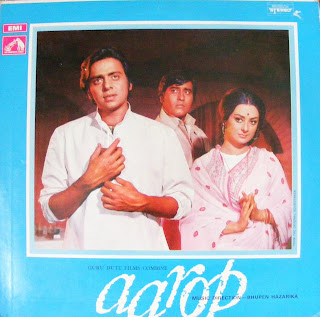
Bhupen Hazarika: Aarop (1973)

Aarop is my first taste of Bhupen Hazaika's music and, as far as I can tell, this soundtrack is distinctly 70's yet the music has a very organic feel. The closest I can compare it to is Ananda Shankar's Sa Re Ga Machan album (you can get a track on eastern eye), yet this one is a lot less experimental and more filmi. This "organic feel" is mostly caused by Hazaika's choice of instruments. Even though most songs have the classic high pitch violin intros, most of the time a light mix of classical and western instruments added to the sweetest melodies which are often played on the flute, are accompanied by some traditional folk instruments. The singers all have very good classical background, especially Manna Dey and Lakshmi Shankar, but you won't hear pure classical music on the record. Basically, this album has great vocals with music that has hints of earthy/indian/filmi/classical/western/folk music etc. Yeah, I know it's a mix of a lot of things, and weirdly enough, except for the last song, each category is so diluted by one or the other, that it creates a united feeling yet at the same time creates one that points in no particular direction.


I would never have guessed that my favourite song on the album, "Jab Se Too Ne Bansi Bajayi Re",was sung by a 47 year old woman. Lakshmi Shankar is a trained classical singer with a lovely youthful voice that portrays, in the song, innocents and a feeling of loss and hope at the same time. I love it.

"Nainon Men Darpan Hai'' is the only song I could find the video for. It is probably the most popular as it is sung by top playback singers Lata Mangeshkar and Kishore Kumar. But I find it very ordinary and moulded to be very filmi. Deja Vu or in this case Deja Entendu. Yawn.


The album ends with a totally R. D. Burman sounding cabaret number that seems a little out of place compared to the rest of the record. I feel as if the composer just wrote it because the film format, especially of the 70's, demanded a sexy upbeat track for the vamp. In this case, the song called "Sub Kuchh Mila Too Na Mila" is sung by no other than Asha Bhosle and, judging by the back cover, is picturised on Bindu.


Even though no specific songs, except "Jab Se Too Ne Bansi Bajayi Re" really capture my attention, the whole soundtrack is well constructed and I feel connected to the overall sound. It's kind of like I know what he's going for, and he's almost there but not quite. Also, I find Hazarika used each singer to his advantage, Lata and Kumar for the popular tune, Asha for the cabaret, Manna Dey to sing for the mature hero and Lakshmi Shankar, somewhat underused, for the simple melody. He knew what each singer could do best.

Enjoy!


For more info on Bhupen Hazarika (he's coming out with a new album) here is a link to a fan blog and to his web site.


Tracks


Side 1


1. Manna Dey: O Phoolon Ke Desh Wali
2. Manna Dey: Haath Mere Hai Madhu Ka Pyala
3. Lata Mangeshkar & Kishore Kumar: Nainon Men Darpan Hai
4. Asha Bhosle: Chale Aao


Side 2


5. Manna Dey: Toot Gaya Mera Sapna Suhana
6. Bhupen Hazarika & K. N. Sharma: Hey Jai Yashoda Nandan
7. Lakshmi Shankar: Jab Se Too Ne Bansi Bajayi Re
8. Asha Bhosle & Chorus: Sub Kuchh Mila Too Na Mila


Lyrics: Maya Govind


Stella_1's score: 3.5/5


Get the music now: Bhupen Hazarika Aarop

Sunday, January 11, 2009

O. P. Nayyar: Kashmir Ki Kali (1964)

The film, Kashmir Ki Kali , introduced Sharmila Tagore to Hindi cinema (she is of course Bengali, and is a distant relative of the TAGORE. Previously, she acted in two Satyajit Ray films, World of Apu (1959) and Devi (1960)) co-starring with an always charming and overly expressive Shammi Kapoor. Even though the film is set in Kashmir, generally for many films, O. P. Nayyar, who is Bengali (Jan. 12th Correction who is Punjabi), focuses on Punjabi folk which I consider to be Nayyar's forte (strength).


The film was a big hit and the soundtrack as well, but I truly think that it was Shammi Kapoor's persona, more than O. P. Nayyar's songs, that helped sell records. Because I find the music not bad, just uninspired.


Two tracks which I enjoy are, firstly, my favorite, "Subhan Allah Haseen Chehra" with Rafi's wonderful voice on the most melodious song on the record, accompaning some folk instuments and harmonium. Secondly, "Meri Jan Bale Bale", (love "Punjabi Shammi" ! My heart goes oy! oy! bale bale!) is a great song but Asha's voice isn't Punjabi sounding at all (Shamshad or Noor Jehan would have been better) and is missing a little authenticity. Though Mohd. Rafi is not "authentic" compared to let's say Gurdas Mann, but he seems to get away with it more easily.


I also enjoy, "Diwana Hua Baadal"but honestly I am not impressed with this album. Maybe my hopes where too high, but I am beginning to become too familiar with O. P. Nayyar's work, and the more I listen too his soundtracks, the more it's all sounding the same. It sounds as if Nayyar would say: "I'm cool. I am the highest paid music director. I sound western and rebellious. Come targeted urban youth! Want to rock'n'roll?". Ah, but this type of music would later become either a musical and creative trap for O. P. Nayyar (or a way to make easy money in the film music industry by duplicating his own style, either way it's starting to get to me. I mean, give me Naushad or give me R. D. Burman, but not the squeaky clean somewhat repetitive attempt to be different. C. Ramchandra was western before him and Shankar Jaikishan could imitate Nayyar better than he could imitate himself with rock'n'roll songs (e.g. Gumnaam, Junglee) which had at least some melody. I know I'm a sucker for classical inspired albums or really wacky musical gems , but O. P. Nayyar is on the bottom in my best composers list. Ok, ok, I will stop this useless rambling, everyone is entitled to their own opinion. So I hope you enjoy the record more than I do! I encourage you too watch the film.


In the 60's there was Kashmir Ki Kali, now we get Mission Kashmir? Sad. One day peace will come and we will be singing and dancing in Kashmir once again.


Tracks:


Side 1


1. Mohd. Rafi: Taarif Karun Kya Uski
2. Mohd. Rafi: Hai Duniya Usiki Zamana Usika
3. Asha Bhosle: Phir Thes Lagi Dil Ko
4. Mohd. Rafi & Asha Bhosle: Meri Jan Bale Bale
5. Asha Bhosle: Balma Khuli Hawa Men


Side 2


6. Mohd. Rafi & Asha Bhosle: Diwana Hua Baadal
7. Mohd. Rafi & Asha Bhosle: Isharon Isharon Men Dil Lene Wale
8. Mohd. Rafi: Subhan Allah Haseen Chehra
9. Mohd. Rafi: Kahin Na Kahin Dil Lagana Padega


Lyrics: S. H. Bihari


Stella_1's score: 3/5


Get the music Now: O. P. Nayyar Kashmir Ki Kali

Friday, December 5, 2008

Hemant Kumar: Sahib Bibi aur Ghulam (1962/1970)

Basically, Sahib Bibi aur Ghulam is a classic Indian film, based on the book by Bimal Mitra. It was India's entry for the Oscars in 1963 and stars Meena Kumari (in one of her most famous roles) as a drunken rich house wife in the province of Bengal during the end of the 1800's.


Initially, I got this album for two songs. The first, and my favorite, "Piya Aiso Jiya Men" is simply a classic Geeta Dutt song that I love. The second is "Sakhiya Aaj Mujhe Neend Nahi Aayegi", beautifully sung by Asha Bhosle and wonderfully picturised by Guru Dutt on the lovely Meenu Mumtaz (Minoo Mumtaz).


But after listening to the album for a while, I slowly fell in love with the song "Meri Baat Rahi Mere Man Me".


It's always a pleasure to hear Geeta Dutt, and on the record you sadly don't get her vocal intro to the song "Chale Aao, Chale Aao" which is in the film (and can be heard in the clip). But Geeta Dutt was most famous for the song "Piya Aiso Jiya Men", as the caracter heartbreakingly calls out to her neglecting husband.

I also enjoy the playful "Bhanwara Bada Nadan" picturised on Waheeda Rehman. But every song on the album has its own charm and I am sure everyone would like one, at the least.

On the back of the record the song titles are translated, so I wrote them down below each one. Enjoy!


I just learned that the film is supposed to be remade, by Rituparno Ghosh starring Salman Khan, Priyanka Chopra and John Abraham(I posted the poster just below.) I don't know? a classic is a classic, I wouldn't have remade it, especially with poptart actors, well it's their chance to prove that they can act, and I hope they succeed.


Tracks:

Side 1


1. Title Music
2. Asha Bhosle: Bhanwara Bada Nadan
Oh! How ignorant is the wasp!
3. Asha Bhosle: Meri Baat Rahi Mere Man Me
Unexpressed remained what I wished to say
(the secret of my heart)
4. Asha Bhosle & Chorus: Sakhiya Aaj Mujhe Neend Nahi Aayegi
Thou dispenser of wine, tonight sleep will forsake me


Side 2


5. Geeta Dutt: Chale Aao, Chale Aao
Come to me, come to me
6. Asha Bhosle: Meri Jaan O Meri Jaan
(Thou art) my life, my life, do not torment me so
7. Geeta Dutt: Piya Aiso Jiya Men
Oh lover! Deep in my heart have you found a place
8. Geeta Dutt: Na Jao Saiyan Chhod Ke Baiyan
Though released is your hand, do not leave me, love


Lyrics: Shakeel Badayuni

Stella_1's score: 4/5


Get the music now: Hemant Kumar Sahib Bibi aur Ghulam

Thursday, December 4, 2008

Usha Khanna: Hawas (1974)

PC and I decided to post this album at the same time, on the same day. (Though I thought it was supposed to be posted at 9 pm, when it was actually 9 am, sorry). I don't know if he liked the record, but I kind of did. (To read what he thought see the post, Hawas)

Hawas creates great atmosphere. But even though it runs in the same vein as the 1973 hits Bobby and Yaadon Ki Baaraat, Hawas is less pop and a little more "soft funk". Or, at the least, it creates a more mature branch of the 1970's teen romance/dramas anyway. Also, Hawas, means "lust"in hindi, so in a sense the music has to be more mature to represent the theme and content of the film.


Usha Khanna is one of the only female music directors in the Indian film industry (some others are Saraswati Devi, Jaddan Bai (Nargis's mother) and Ishrat Sultana). She started her career with Dil Deke Dekho in 1959 which was primarily based on western rock'n'roll, and as with Hawas, though now in the 70's, she remaines inspired by western music but certainly had evolved with the changing times.


The best songs on the record are the "vamp songs" sung by Asha Bhosle. You have "Aao Yaro Gao", that has to be my favorite on the album for "semi bad girl" Rekha, and for the classic bad girl Bindu ,"Apne Dil Men Jagah Dijiye" is ok but I actually like the intro better then the song itself.

For the rest of the tracks, "Yeh Hawas Kya Hai" (Again, an amazing intro and great mood) is pretty good,"Teri Galiyon Men" is ok and "Kal Raat Usne" is nothing special.


And that is actually it, because there are only 5 tracks. So enjoy!

(I added a picture of the original record cover on the left!)


Tracks:


Side 1


1. Asha Bhosle & Chorus: Aao Yaro Gao
2. Asha Bhosle: Yeh Hawas Kya Hai


Side 2


3. Mohd. Rafi: Teri Galiyon Men
4. Asha Bhosle: Apne Dil Men Jagah Dijiye
5. Asha Bhosle: Kal Raat Usne


Lyrics: Sawan Kumar

Stella_1's score: 3.5/5

Get the Music Now: Usha Khanna Hawas

Monday, October 13, 2008

Naushad: Gunga Jumna (1961/1978)

The soundtrack to Gunga Jumna runs in the same veins as O. P. Nayyar's music for the 1957 film Naya Daur. The music also resembles some of Naushad's earlier work in Amar (1954), especially in what I like to call the "village girl songs". In short, the sound is not original, but that does not take away from the quality of Naushad's work. Gunga Jumna was nominated for a Filmfare award that year.

As far as the plot goes the now famous pair (after the success of Devdas in 1955, Naya Daur in 1957 and Madhumati in 1958) goes on to make another hit by playing lovers in early post-independent India. With Dilip Kumar playing the role of the hard working Gunga and Kumar's fictional well educated brother Jumna played by his real brother Nasir Khan, with Vyjayanthimala as the lovely and colourful heroine. Themes such as right vs wrong, village vs city and battling social status of the new educated vs uneducated India live together and create friction in the film.

But if we come back to the music, it is mostly based on folk, with it's regional instruments and simple melodies.

To start, we have the beautiful Helen doing some Kathak on "Tora Man Bada Papi", well it's more like dancing around (it's good dancing, but not Kathak) in a Kathak outfit, not actually dancing a classical Indian form. The song is kind of plain, it does not interest me much, but I like the video.


After, looking at the big difference between the lives of the two brothers (Ganga and Jumna) as children, the video reflex's the contrast present in society of the "new India". This patriotic song, "Insaf Ki Dagar Pe" is a little to idealistic, but at least it is looking to a bring future. Everyone needs hope.


My favorite song has to be "Do Hanson Ka Joda", I love the sarangi (or sarod, I'm not sure), its beautiful. It's sad, simple and sweet.


Two other songs that I like are "Jhanan Ghoongar Baje" and "Dagabaz Tori Batian", because they are joyful and playful.

"O Chhalia Re Chhalia" and "Naina Lad Jaihen" (in this one you get Dilip Kumar dancing, yay!) just didn't get me moving. Ok....my foot was taping, but I expected more.

Overall, there are more ordinary songs than good songs. The album flows very well and I am sure Naushad put effort into this soundtrack.


Tracks:

Side 1

1. Lata Mangeshkar: Dagabaz Tori Batian
2. Lata Mangeshkar, Mohd. Rafi and Chorus: O Chhalia re Chhalia
3. Lata Mangeshkar & Chorus: Jhanan Ghoongar Baje
4. Mohd. Rafi: Naina Lad Jaihen


Side 2


5. Lata Mangeshkar: Do Hanson Ka Joda
6. Hemant Kumar & Chorus: Insaf Ki Dagar Pe
7. Asha Bhosle: Tora Man Bada Papi
8. Lata Mangeshkar: Dhoondo Dhoondo Re Sajna


Lyrics: Shakeel Badayuni


Stella_1's score: 3.5/5


Get the music now: Naushad Gunga Jumna

Thursday, July 3, 2008

Rahul Dev Burman: Yaadon Ki Baaraat (1973)

Yaadon Ki Baaraat is one of my favorite soundtracks, almost all the songs are great on there own as well as in a whole. Burman creates music for the youth of India, fresh, western and wacky, just the right stuff to get the conservative parents angry. It's not serious music but it's good music.


The plot of the movie centers around three brothers who's parents were killed mainly because their father was a painter who could paint and identify the face of a thief who robed a bank. (As tough being a blond bearded and haired Indian man isn't enough for the police to identify him.)

Anyway, the first song is before all the killing. The perfect little family sings the title song ''Yaadon Ki Baaraat''. If you watch the clip, how could a beautiful girl like that end up with a man like that, (Besides the fact that he has that artist-musician- guy with cool glasses thing going on) it must have been an arranged marriage. Also interesting is that in the clip the youngest boy is played by a little Aamir Khan. And an other plus is that the children singing playback are Padmini Kolhapure and her sister.

The very popular ''Chura Liya Hai Tum Ne'' is actually inspired by the Title Track for the 1969 film, If it's Tuesday, it must be Belgium. The Burman track has some of the best Asha vocals.


''Lekar Hum Diwana Dil'' has to be my favorite. It's pure fun. This song with funky music and great vocals made Neetu Singh a star.

The youngest brother, Ratan aka Mondo sings ''Aap Ke Kamre Men'' which is a medley of songs split between a few Hinglish phrases (Come on, sing baby!) My favorite part of the song is when they start singing ''hare ha ha'' with a musical interlude including the finale "Dum Maro Dum" from Zeenat Aman and R. D. Burman's earlier hit Hare Rama Hare Krishna(1971)


You also have the second version of ''Yaadon Ki Baaraat'' when the brothers reunite. Ah! They can once again be a family.

The song ''O Meri Soni'' is the one I like the least, but it still has it's charm especially in the instrumental parts.


And remember, never trust a man with different shoe sizes, especially size 8 and 9. He is probably the one that killed your parents when you when young. Even if you're not a orphan just watch out! Oh, ya, and you never know who could be on the other side of sliding walls, so beware.

Music from the Third Floor also reviewed this album,Yaadon Ki Baaraat , take a look at what he thinks.


Telugu remake "Annadammula Anubandham", made in 1975. Here are some videos:

Churaliya-Telugu

Lekar Hum-Telugu

Yaadon Ki Baaraat-Telugu


Tracks:


Side 1
1. Asha Bhosle & Kishore Kumar: Lekar Hum Diwana Dil
2. Asha Bhosle, Kishore Kumar & R. D. Burman: Aap Ke Kamre Men


Side 2
3. Asha Bhosle & Kishore Kumar: O Meri Soni
4. Lata Mangeshkar, Padmini, Shivangi & Chorus: Yaadon Ki Baaraat
5. Asha Bhosle & Mohd. Rafi: Chura Liya Hai Tum Ne
6. Kishore Kumar & Mohd. Rafi: Yaadon Ki Baaraat


Lyrics: Majrooh


Stella_1's score: 4/5


Get the music now: R. D. Burman Yaadon Ki Baaraat

Tuesday, June 10, 2008

O. P. Nayyar: Kismat (1968)

At the first glance, you know that this record is certainly not like Phagun. Instead, Kismat incarnates the typical rebel O. P. Nayyar style. His music was rebellious for it's time, but now it's pretty clean, so let's just call his style non traditional. On this record he is inspired by some jazzy rock'n'roll of the 60's with a little folk as well.


In general the songs are very guitar based. You have the almost county "Lakhon Hain Yahan Dilwale" and the bouncy "Aankhon Men Qayamat Ke Kajal".You also get great instrumentals with "One Two three Baby" which is also available on Bombshell Baby of Bombay vol.2, that you can find on Bombay-Connection Records.

My favorites are the Punjabi inspired "Karja Mohhabat Wala" and the heroine's drunk song "Aao Huzoor Tumko".


I understand that O. P. Nayyar makes the music and melodies simple as to make it easy for the viewers to instantly connect with the songs. But from my personal perspective, I feel that the music is in need of multiple layers, but he doesn't provide that. I prefer O. P. Nayyar's earlier work such as Aar Par, Tumsa Nahin Dekha, Paghun and Naya Daur. In the 60's he was popular because he did not follow trends, he made them. But I have a feeling that during this period when Kismat came out, he was just copying his own music, making this record unoriginal and a bit boring to listen to today.


But I still like to rock'n'roll from time to time. So Baby, tell me what you think!


Tracks:


Side 1
1. Mahendra Kapoor: Aankhon Men Qayamat Ke Kajal
2. Asha Bhosle & Shamshad Begum: Karja Mohhabat Wala
3. Title Music


Side 2
4. Asha Bhosle: Aao Huzoor Tumko
5. Mahendra Kapoor: Lakhon Hain Yahan Dilwale
6. Mahendra Kapoor: One Two Three Baby


Lyrics: Noor Dewasi & S. H. Bihari


Stella_1's score: 3 /5


Get the music now: O. P. Nayyar Kismat

Friday, March 28, 2008

Roshan: Bawre Nain (1950/1980)

Roshan, who was a musician trough out the 40's, got his first break as a music director with Bawre Nain. Heavily inspired by the 40's sound, this record represents the end of an era and the beginning of a new one. But the overall sound of this album is melancholic and slightly romantic (as in the artistic current).  

The most popular song on the record is ''Khyalon Men Kisi Ke'', it's sneaky and seductive.

You can find some joyful songs on the album, but you still feel some pain in the music. Like the playful ''Mujhe Sach Sach Batado'' and ''Roothe Hue Chanda''. They still feel a little bit like when someone sad tries to be happy.

My favorite songs on the album are the lonely ''Teri Duniya Men Dil Lagta Nahin'', the lovely duet ''Mohabbat Ke Maron Ka'' and ''Sun Bairi Balam''

It's not the greatest album, but still it is special. It has it's own original charm that makes it stand out. I enjoy it, what do you think? 


Tracks:

Side 1
1. Geeta Dutt & Mukesh: Khyalon Men Kisi Ke
2. Rajkumari & Mukesh: Mujhe Sach Sach Batado
3. Rajkumari: Roothe Hue Chanda


Side 2
4. Mukesh: Teri Duniya Men Dil Lagta Nahin
5. Mohd. Rafi & Asha Bhosle: Mohabbat Ke Maron Ka
6. Rajkumari: Kyon Mere Dil Men
7. Rajkumari: Sun Bairi Balam


Lyrics: Kidar Sharma


Stella_1's score: 3.5/5


Get the music now: Roshan | Bawre Nain

Wednesday, March 5, 2008

N. Dutta: Sadhna (1958/1982)


In the early days, N. Dutta was the assistant to musical director S. D. Burman , so I was scared that there would be a S. D. Burman clone out there, but ''S. D. Burman the second'' he is not (I was relieved). N. Dutta's soundtrack for Sadhna is a little unexpected gem. Every song has it's own charm, making none of them a bore to listen to.


In the film,Vyjayanthimala (one of my favorite and one of the best dancers in Indian cinema) plays a courtesan. Thank god, because that's a good excuse for great dancing (Kathak) and great music.Well it basically insists on having a brothel scene, ''Kahoji Tum Kya Kya Kharidoge'' is what you get. The tabla is great and there are just enough rhythm changes to make you head spin (but in a totally good way).

Like I said in my last post, the best qawwali that I've heard up to date is ''Aaj Kyon Hamse Parda Hai'' . It has great music and vocals.

Next on my favorite list is a song sung by Geeta Dutt, Yeay! (Her and Shamshad Begum have to be the best playback singers ever). We only get one song on the album sung by her, but it's one of the best. ''Tora Manva Kyo Ghabraye'' is a mellow song with a timeless memory. It has a sweet into as well (nice flute).

The rest of the songs ''Aise Vaise Thikane Pe Jana Bura Hai'' , ''Sambhal Ae Dil'' and ''Aurat Ne Janam Diya Mardon Ko'' are quite nice. I enjoy this album very much. What do you think?


Tracks:


Side 1
1. Lata Mangeshkar: Kahoji Tum Kya Kya Kharidoge
2. Lata Mangeshkar: Aise Vaise Thikane Pe Jana Bura Hai
3. Asha Bhosle & Mohd. Rafi: Sambhal Ae Dil


Side 2
4. Mohd. Rafi & Balbir: Aaj Kyon Hamse Parda Hai
5. Lata Mangeshkar: Aurat Ne Janam Diya Mardon Ko
6. Geeta Dutt: Tora Manva Kyo Ghabraye


Lyrics: Sahir

Stella_1's score: 4/5

Get the music now: N. Dutta Sadhna

Bappi Lahiri: Pyaas (1982)


Pyaas is a good record, but it was released in 1982 the same year that Disco Dancer and Namak Halaal came out. The music is ok but it could never beat those two soundtracks.


"Om Namah Shivae" (Male), I first heard on the "Disco CD" on Bollywood for beginner's vol.2. But there are two versions on the record. The first is sung by Kishore Kumar and his son Amit Kumar. This version, my favorite, is more disco-funk and longer than the second. Asha Bhosle (who is starting to get older and it shows in her voice as well) sings the softer version. Strangely, this one loosely resembles The Lipps 1980 release and mega hit "Funkytown".


For the rest of the songs Bappi Lahiri cools the disco down and moves towards a slower more traditional and mellow vibe. Aspecially, with "Dard Ki Ragini", Lata almost goes semi-classical, well maybe not, but for Bappi it's close.

Sorry the quality of second side of the album isn't very good. Too bad because I enjoy the soft "Sath Mera Chhodakar". So sorry for the clicks. And while I am apologising, I am sorry but I couldn't find one video of Pyaas, so sorry again.

Yes, this album has a qawwali too, "Hamari Yaad Ki" which is quite nice. (My next record post has a qawwali as well, that's even better. I guess that it's my current theme at the moment, 3 records in a row)

Anyway, listen and tell me what you think!


Tracks:

Side 1
1. Kishore Kumar, Amit Kumar & Chorus: Om Namah Shivae
2. Asha Bhosle: Raat Sone Ko Hai
3. Kishore Kumar & Manna Dey: Phool Chahiye Na
4. Lata Mangeshkar: Dard Ki Ragini


Side 2
5. Asha Bhosle: Om Namah Shivae
6. Kishore Kumar & Chorus: Sath Mera Chhodkar
7. Mahendra Kapoor & Chorus: Hamari Yaad Ki (qawwali)
8. Kishore Kumar: Phool Chahiye Na (Sad)


Lyrics: Kulwant Jani, Naqsh Lyallpuri & Shiv Kumar Saroj

Stella_1's score: 3/5

Get the music now: Bappi Lahiri Pyaas